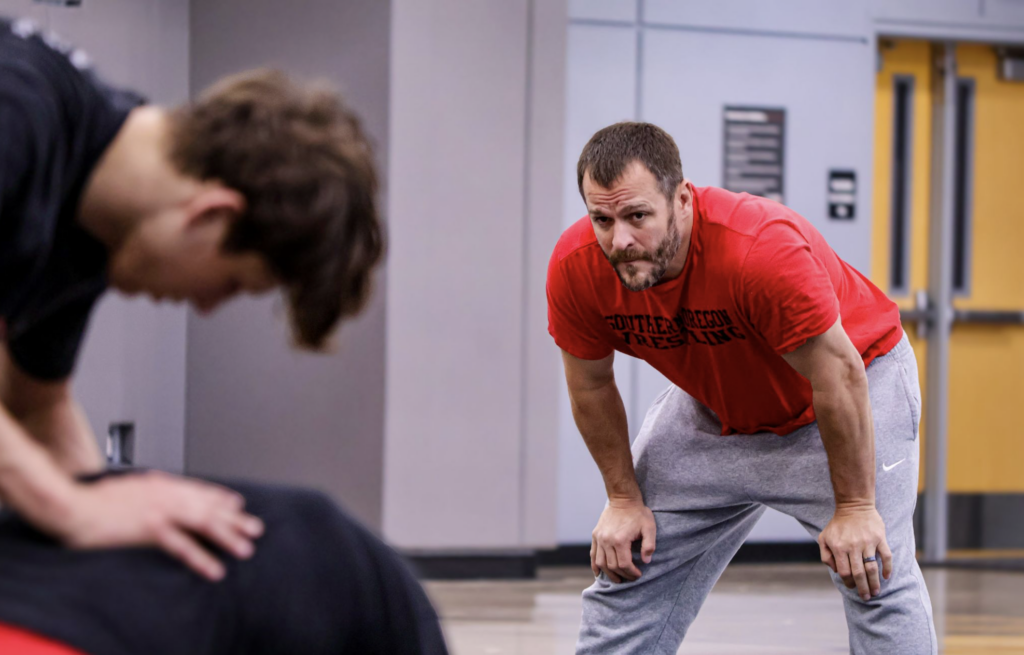
Southern Oregon University men’s wrestling coach Joel Gibson was holed up in his office studying film from the Cascade Collegiate Conference Championship tournament.
It was the kind of scene that said plenty before Gibson said anything at all.
The Raiders had just brought home individual championships in five of the 10 weight divisions contested, with several others placing throughout the tournament. Southern Oregon finished the season with a 16-1 dual record, secured its second straight CCC Men’s Wrestling Championship, and Gibson was named the conference’s Coach of the Year for the second year in a row.
Still, Gibson was back in his office, locked into the details.
“Pull up a seat,” Gibson told me. “Watch this!”
For Gibson, the championship was not just a celebration. It was a confirmation of the standard he has built at Southern Oregon.
Gibson, who wrestled at Oregon State before finishing his on-mat career at Southern Oregon in the early 2000s, returned after building a resume in coaching in 2017 as an assistant coach. He became a head coach in 2019.
Coach Gibson credits his competitive drive as the factor that fuels him to continue his role in sports beyond active competition. Now engaging with sports from the bench, his focus has also had to shift. While his job title may be head coach, his leadership role does not end when the gym doors close.
Outside of the gym, Gibson provides leadership, structure, mentorship, and accountability to men learning how to navigate the responsibilities of young adulthood.
“We really focus on the little things, like making sure they’re on time, doing the right things off the mat, making sure they have good grades,” Gibson said. “Sometimes that can be hard, but we set a high standard.”
Since taking over SOU’s head coaching role, Coach Gibson has consistently produced more National Championship Qualifying wrestlers each year.
Gibson’s success since taking over at Southern Oregon is not by chance — it is by design.
Gibson stresses that he and his staff value strong character over pure talent when evaluating potential recruits, structuring the team’s approach to develop talented individuals that demonstrate good character, rather than recruiting based on skill alone.
He credits the team’s success to the type of wrestlers that he and his staff have recruited. “There’s a lot of guys that can wrestle – we’d rather have the guys that are good people, too,” Gibson added.
Gibson also credited his coaching staff for the program’s success, stating “when you surround yourself with the right people, everyone lifts one another up.”
“Joel does a good job because he’s overseeing everything, but he’s not afraid to delegate and let guys contribute,” said Assistant Coach Tucker VanMatre. “He really likes to play to the coaches’ strengths and utilize his staff.”
More evidence of what makes Gibson a great coach is found in the wrestlers he refuses to give up on.
When Adrian Chavez-Morales arrived at Southern Oregon after junior college, he wasn’t just looking for a wrestling opportunity. He was trying to escape himself.
“I was a liar and a thief and a criminal,” Chavez-Morales said. “I had a bad attitude. I wanted to fight all the time. I hated everybody and everything. I was just a sad, lost person.”
He had been drinking heavily since he was a teenager. At one point, he was consuming a fifth of alcohol a day. He did not expect that to change.
“I thought I’d never stop drinking,” he said.
Gibson was the last coach to recruit him. But he was the only one who showed up immediately — arranging a visit within weeks and personally picking Adrian up from a tournament.
That mattered.
“My pops always told me, ‘Go with the one showing you the most love,’” Adrian said. “Joel showed me he cared.”
Once in Ashland, that care came with confrontation. Gibson didn’t excuse behavior. He corrected it, and sometimes bluntly. On one road trip, Adrian casually tossed trash near a storefront statue. Gibson stopped him.
“Get back here, and pick up your trash!” Adrian recalled. “Nobody shakes me. Joel’s the only person in the world that does.”
It wasn’t about litter. It was about standards.
“There’s no room to fail,” Adrian said. “If you mess up, he’s going to talk to you. He’s going to tell you to fix it. If it happens again, there are consequences. But you always know what the standard is.”
Confronting Adrian’s substance abuse, Gibson didn’t just warn him. His program offered support. VanMatre drove him to Alcoholics Anonymous meetings — and sat through them with him.
“He put his hands into my situation,” Adrian said. “People would tell me, ‘It’s not good to drink.’ He was the first person who actually stepped in.”
Nearly two years sober, Adrian was crowned 2025-26 CCC Men’s Wrestling Champion at 184 lbs, and is ranked No. 4 going into Nationals. He credits Gibson not only for his success on the mat, but for his survival.
“I was tired of being nobody, but I didn’t want to be anybody. I wanted to be somebody — and Joel made that happen,” Chavez-Morales said. “I’d be dead or in jail right now if it wasn’t for Joel.”
When discussing Adrian’s transformation from an addict to a conference wrestling champion,
Coach Gibson beamed with pride while recounting his redemption and triumph. Gibson went on to describe the experience as “one of the most gratifying things I’ve been a part of.”
That, more than the trophies, explains the program Gibson has built.
Southern Oregon’s conference championship season was not only the result of strong wrestlers winning matches. It was the product of a culture built around accountability, trust and the belief that standards matter most when they are applied every day.
For Gibson, success is measured as much by who his wrestlers become as by how they compete.
And after a second straight Cascade Collegiate Conference championship, Southern Oregon’s standard — both in wrestling and in character — is in capable hands.
This story was produced in the Winter 2026 section of COMM322 – Online Journalism at Southern Oregon University
Photo by Codi Kirksey/p1sportsmedia.com