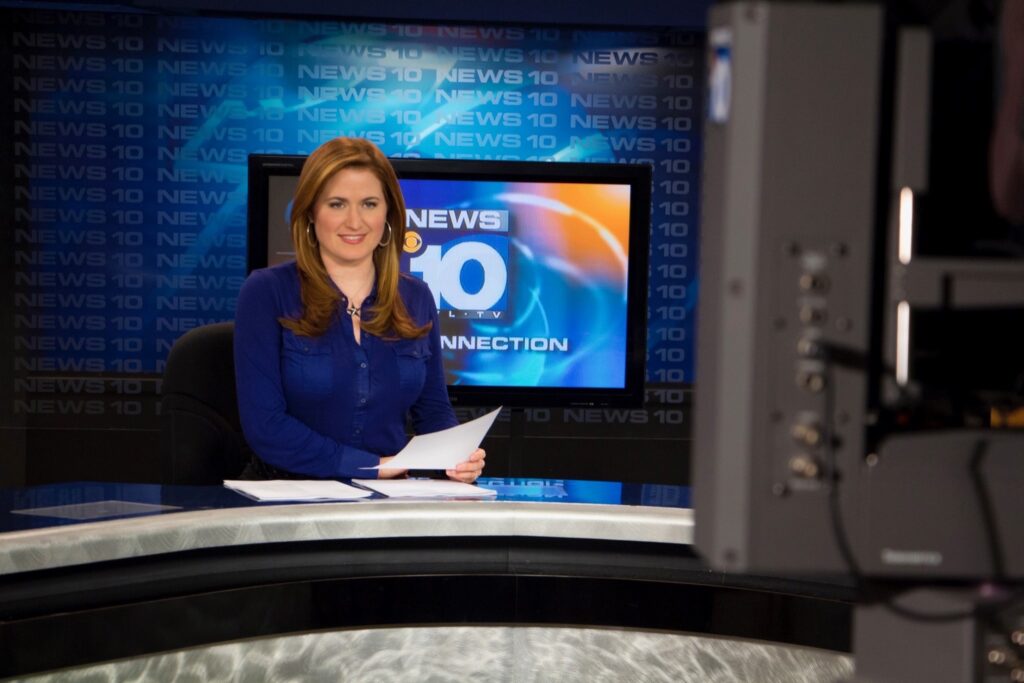
Even before she became a familiar face in Oregon journalism, and later the creator of her own successful digital storytelling venture, Trish Glose was simply someone who loved stories, and had the determination to tell them well.
With nearly two decades in the newsroom as a reporter, anchor, producer, and executive producer, Glose built a career rooted in accuracy, curiosity, and the belief that journalism serves the community by uncovering truth. Today, she continues that work in new creative forms through her food and wine show and video podcast, proving that great storytelling evolves, but never loses its purpose.
Glose began her career with KTVL News in Medford, and worked as a reporter, producer, anchor and news director during 20 years with the station. She recently connected with Southern Oregon University student Julianna Chavez for a deep dive on her take on journalism today, and best practices for professional success.
This interview has been edited for clarity and length.
What inspired you to pursue a career in journalism?
I think curiosity, and wanting to know why, wanting to know where this person’s from, why they got into what they were doing in the moment. Especially for me, it’s people, but then also just the ways of the world, and how our government works, how organizations work, how universities function. That curiosity is really what led me into this path.
I was a theater nerd, and I loved being on stage, and I loved presenting things. So I think whenever you can find two passions, and you can make them kind of go into one avenue, that’s always a good idea, because then it’s something that you naturally love doing.
How was your experience working for KTVL, and evolving as a reporter and anchor?
Working for them was great. I knew I wanted to go into journalism, but I realized I wanted to be a reporter when I did internships in college, and my internships really sealed the deal for me.
Reporters are on the front line. They are the ones going out to interview people, to capture video, to capture sound, and to create a story based on whatever they gather for the day. It was the idea of being on the front line, where I’m in charge of my story. There’s no one else in the newsroom who’s on this story but me, and they’re depending on me to bring back all the critical information that we need to share with our viewers.
It’s public service. It’s something that we provide our listeners and our audience every day. So, if there’s a traffic jam, if there’s a wildfire raging through the city, if there’s something that we have to tell our viewers about, that’s our job, and they should depend on us to give them accurate, ethical information.
How did you get your first internship?
I just started calling up stations where I lived, in Reno, and then I spent a summer in Las Vegas and interned at a station down there. I wanted to work in a big market, to see how that functioned, and I just called the newsroom and said, hey, I’m a college student, I’m looking for an internship, do you have someone who’s in charge of interns, or do you have interns?
But I will say that the knowledge that you gain is incredible. Especially if you are looking to go into journalism, you will probably be a one-man band. They call them multimedia journalists now. So, you’re doing the videography, you’re doing the interviewing, you’re doing the editing, you’re doing the web story, you’re putting up social media.
You left KTVL in 2021. What are you doing now?
I have a show that I launched on YouTube last year, where I go out and interview food and beverage industry people. I find interesting chefs, winemakers, and cidery owners. I create a story around them, and showcase they do and why they do it.
I learned how to edit video in a broadcast journalism class, but anyone can also get started on your own. I suggest coming up with a story, and doing it on your phone. Get a mic that plugs into your phone, interview people, capture video, and create a one-minute story on something. Maybe it’s on campus, maybe it’s around Ashland.
The more you build that muscle memory of how you do things, the more it will help you.
How do you prepare for interviews or live reporting?
I would say the number one rule is you have to know the subject. You have to know what you’re talking about, especially for live reporting. If it’s a story that you’ve been covering all day, you should know the ins and outs of it very well. If it’s breaking news, that’s a different story. What’s the topic of discussion? Is there something in city council meetings that I can go look up? Are there newspaper articles on this that I can go read really quickly?
Out of all the stories you’ve covered, are there any that really stick out to you, or that you remember?
There was something happening with the Oregon Health Plan. They were running out of funds, and they were shifting the people in the state who they were helping. We had story after story of those on the Oregon Health Plan who were essentially getting kicked off. People with cancer, people who are dependent on medications, and dependent on procedures.
Just to hear their stories of desperation was so important.
You’re the voice for the underdog. You’re the voice for the people who maybe don’t have a platform to share their story. And I love that. I love being that connector.
What are the biggest challenges within journalism?
It’s hard work. Especially in your first market, you’re doing everything yourself.
It’s learning how to do all these things. You’re not asking questions, you’re shooting video, you’re writing, you’re doing all these things in a matter of a few hours, in one day.
Sometimes people call you back, and you really want to produce their story, but it falls through, and so you’ve wasted an entire day. There’s nothing worse than when your story falls through.
If I’m looking for an internship, or just wanting to pursue that career in journalism, what can I do to stand out?
I would love to know what classes you’ve taken to help you prepare for this role. I would let them know your goals.
At least to a news director, don’t ever say, I want to be a TV anchor. I’ve heard this a lot. And it tells me you don’t want to work. Because you just want to benefit from all the work of others, and you just want to be on TV.
I want journalists, I want reporters and journalists who are interested in finding the truth, and finding the story, and sharing that. Reporters do the majority of the work in broadcast journalism.
What last words do you want to share with readers of this interview?
I got into the business because the idea of being on camera was super fun. Then the more I fell in love with the job, it became less about being on camera and more about telling a good story.
Anybody can get on camera and read the story, right? It takes a really special, talented, smart person to be able to talk to people, get information, and turn that into something that people learn from.
That’s a very noble and special job.
This interview emerged from an assignment in SOU’s course on Interviewing & Listening. Any students inspired by Glose’s insights on broadcast journalism are encouraged to explore other related curriculum offered by the department of Communication, Media & Cinema, including Multimedia Writing, Online Journalism, Broadcast Journalism, and Media Ethics & Law.
Photo courtesy of Trish Glose