As the federal government’s current shutdown grinds on, many Southern Oregon University students are beginning to confront uncertainty around the federal government’s Supplemental Nutrition Assistance Program (SNAP) benefits.
Many students already face food and financial insecurity, and their struggles were amplified starting Nov. 1. Funding for SNAP benefits and many other government payments lapsed following the failure of President Donald Trump’s administration and Congress to re-authorize food payments relied on by millions of Americans.
Knowing that students will feel impacts from the shutdown, Southern Oregon University President Rick Bailey issued a Friday Message on October 24.
“We have the power within ourselves to move forward and beyond any feelings of helplessness or anger,” Bailey said.
While Bailey leads the University through the uncertainties that lie ahead with this federal shutdown, many other leaders on campus are ready to jump in and lead students through uncertain times. These include Ronald King, the Benefits Coordinator with the Office of the Dean of Students and organizer of the Student Food Pantry on SOU’s Ashland Campus.
All SOU students have access to the resources of the Food Pantry, which is located in Stevenson Union 312. Founded in 2012, the Food Pantry serves SOU both resident and commuter students.
“You can simply stop by the pantry in the Stevenson Union and pick out up to 10 non-perishable food items and unlimited (within reason) perishable/hygiene items,” said King. Both he and his staff report that use of the food pantry has increased recently; however, they are keeping the shelves as stocked as resources and donations allow.
“While we budget our money to meet needs, often our funds fall short each month in terms of purchasing foods,” said one student. “At the SOU Food Pantry, we would get easy meals for free. These free foods really helped to sustain us as we pursue our goals in life.”
Another student noted that the food pantry can play a small but significant role in getting through short-term struggles.
“It was so helpful to be able to go get a few necessities to help get me through a couple of weeks that were really hard,” they said. “I had run out of food and money and wasn’t yet receiving food stamps.”
If you would like to support the food pantry, financial and food donations are welcomed year-round. Financial donations to the food pantry can be made at http://go.sou.edu/give2pantry. If you have any questions regarding SOU’s Food Pantry, please reach out to Ron King at kingr@sou.edu.
Students can also rely on campus and local options to become more thrifty in their shopping and dining habits.
Check your meal plan if you live on campus. While the desire to go to one of the restaurants adjacent to campus may be tempting, your swipes at The Hawk are pre-paid. If you find that you frequently have meals leftover at the end of each week, inquire about options for modifying your meal plan.
Alternatively, if you find that you sometimes have a meal leftover, you could consider donating swipes to the Raiders Helping Raiders Program. The Raiders Helping Raiders program allows students facing food insecurity to apply to receive up to three meals per month at The Hawk. To apply or for more information, please visit https://dos.sou.edu/find-support/raiders-helping-raiders/.
For those residing in Student And Family Housing or off-campus, you are eligible for a community meal plan at The Hawk. Purchased in blocks, community meal plans are offered in 20-, 30-, and 65-meal packages at an effective price of approximately $9.50 each. These plans are available for purchase at The Hawk.
“Yeah, we’ve definitely made some cuts at home,” remarked one student residing in Student And Family Housing. “But sometimes, it’s not practical to cook, and it’s easier to go out. It’s not as cheap as preparing a meal at home, but it is less expensive than a meal at just about any restaurant.”
The Hawk also offers Raiders Repack, its lowest cost meal option, following evening service. For more information on community dining plans or Raiders Repack, reach out to The Hawk.
Another great lower-cost food option is the prepared meals stocked in the local grocery stores. The cost of these items will be comparable to the raw ingredients required for a similar meal. These meals are characterised by being packaged fresh in oven-ready containers. These will be great alternatives when time is a premium commodity, and as we enter the back half of the quarter and term projects become due.
Albertsons and Safeway both offer single-portion meal options. Market of Choice has similar offerings and also offers meals with portions for 4-6 in the $25-$35 range. That comes out to less than $10 per person for a family of four. The great thing about these options is that they only require an oven to prepare, which makes for a great option for students living on campus.
“It’s not always the cheapest option, but I don’t have to buy the ingredients, I don’t have to prep anything, or wash any dishes afterwards,” said one father and student. “It’s a reliable option, and I save quite a bit of time. My kids love it. My wife loves it. And I get quite a bit of my night back.”
If you have not established a Mutual Aid Network, now is the time to consider doing so. While mutual aid groups do not have to be massive organizations, a minimum of 4-6 is necessary to form an effective mutual aid group. Pooling your resources and splitting costs on bulk quantities of common-use items, such as household items, food, and toiletries, can be an incredible way to save money. Maybe your mutual aid group could enjoy a potluck or prepared family-style meal instead of ordering in while cramming for exams or gathering to work on group projects.
While it may be convenient to visit a local merchant near campus for one or two light cleaning supplies in an emergency, the financial reality is that local merchants don’t have the purchasing power to offer competitive pricing on these items against what a wholesale club, such as Sam’s or Costco, offers. While there are no Sam’s Clubs locally, Costco has a location near Rogue Valley International Airport in Medford.
While a wholesale club will charge an upfront membership fee, the savings of pooling resources, purchasing in bulk, and dividing equally can easily cover the cost of membership in the first couple of months. If you already know someone with a membership to a wholesale club, that lowers your barrier to access.
Only one person in your resource group needs to join your chosen wholesale club. Most clubs offer a “partner” to be on the membership, but the designated partner must reside at the same address as the primary member. It’s important to note that these clubs will usually allow one guest that is not listed on the account to access the club with a member. It is recommended to create a shopping list as the entire group will not be able to go shopping together. With careful planning, pooling resources and buying common-use items in bulk can offer great savings.
There are many other options available through private outreach programs locally. Below is a list of programs in the Jackson County area. Please be sure to confirm days and hours of operations directly with the organization.
ASHLAND
Ashland Community Food Bank
560 Clover Ln.
Hours: Monday–Friday, 9:30 AM – 12:30 PM | 3rd Saturday, 9:30 AM – 12:30 PM
Ashland First United Methodist Church*
175 N. Main St.
Hours: Wednesday, 2:00 – 4:00 PM
Greensprings Community Food Pantry*
16151 Oregon 66
Hours: 3rd Saturday, 8:30 – 11:30 AM
MEDFORD
Salvation Army
922 N. Central Ave.
Hours: Monday, Thursday, Friday, 9:00 AM – 12:00 PM & 12:00 – 3:00 PM
First Christian Church*
1900 Crater Lake Ave.
Hours: Monday, 11:15 AM – 1:30 PM
Teresa McCormick Center
2600 S. Pacific Hwy.
Hours: Monday, 2:00 – 4:30 PM | Thursday, 10:00 AM – 1:00 PM
Set Free Services
1032 W. Main St.
Hours: Monday, Wednesday, Friday, 10:00 AM – 3:00 PM
First Presbyterian Church
85 S. Holly St.
Hours: Monday–Thursday, 9:00 AM – 12:00 PM
Additional site: Tuesday, 1:00 – 4:00 PM (750 N. Columbus Ave.)
Rogue Food Unites Mobile Pantry (Way Church)
2655 S. Pacific Hwy.
Hours: Tuesday, 4:00 – 6:00 PM
West Medford Pantry*
750 N. Columbus Ave. (enter lot on Priddy St.)
Hours: Tuesday, 12:30 – 3:00 PM
Unete ACCESS Mobile Pantry
607 W. Main St.
Hours: Wednesday, 12:00 – 2:00 PM
Medford First United Methodist Church
607 W. Main St.
Hours: Wednesday, 1:00 – 3:00 PM
St. Mark’s Episcopal Church*
140 N. Oakdale Ave.
Hours: Wednesday, 9:15 – 11:00 AM
The Roxy Food Pantry*
1015 S. Riverside Ave.
Hours: Thursday, 1:30 – 3:00 PM
God’s Food Pantry*
1032 W. Main St.
Hours: Friday, 9:30 AM – 12:30 PM
La Clinica Wellness Center*
730 Biddle Rd.
Hours: Friday, 9:00 – 10:00 AM
St. Vincent de Paul
2424 N. Pacific Hwy.
Hours: 3rd & 4th Fridays, 11:00 AM – 1:00 PM
PHOENIX
1st Phoenix Community Center
121 W. 2nd St.
Hours: Wednesday, 1:00 – 3:00 PM
CENTRAL POINT
Central Point Pantry*
399 S. 5th St.
Hours: Tuesday, 9:30 AM – 12:30 PM
Calvary Neighborhood Outreach Pantry
513 E. Pine St.
Hours: Saturday, 11:00 AM – 1:00 PM
FREE COMMUNITY HOT MEALS
St. Vincent de Paul — Free lunch Monday–Friday, 11:00 AM – 1:00 PM
Ashland Community Peace Meal — Thursdays & Fridays, 3:30 PM at Lithia Park Gazebo
Uncle Food’s Diner (Peace House) — Tuesdays, downtown Ashland (2nd St.)
Potluck on the Plaza — Wednesdays, 4:00 PM at Lithia Park Gazebo
Saturday Community BIPOC Sanctuary — Saturdays, 12:00 – 2:00 PM at Ashland Library (Guanajuato Room)
Sunday Komack Soup — Sundays, 5:00 PM at Lithia Park Gazebo
Note: Student names have been omitted intentionally in order to safeguard their privacy and dignity in appreciation for their candidness while speaking about their personal experiences regarding this sensitive subject matter.
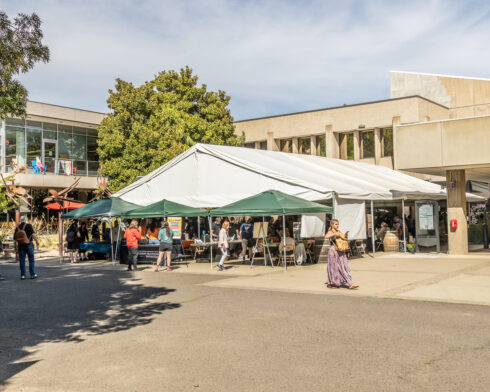
Photo by Codi Kirksey/The Siskiyou